
Can you handle the (compassionate) truth?

“You can’t handle the truth”

You may not have heard of Deep Adaptation. Not many of us scour the internet looking for academic papers to read, and the truth of our current environmental and social situation is a lot harder to digest than a cute cat video. If you were to read the freely available paper, you might be interested to know what sets the Deep Adaptation paper apart from other academic texts. Authored by Professor Jem Bendell in 2018, it was rejected for academic publication during the peer review process. As is standard academic process, the writer must reference other academic research in the form of a literature review, with which to validate and strengthen their hypothesis. In other words, without giving a shout out to your peers, you can’t be in the club.

The German physicist Max Planck said that science advances one funeral at a time. That makes advances pretty slow, just when it appears we don’t have time to lose. The purpose of the Deep Adaptation paper is exactly this: to face the truth. We are already experiencing social and environmental collapse. This collapse will continue to increase global impacts. Impacts such as increased food scarcity, conflict, extreme weather, forced migration and biodiversity loss. As Bendell states in the preamble to the paper, ‘a reviewer’s request not to dishearten readers with the claim of “inevitable near-term social collapse” reflects a form of censure found amongst people working on sustainable business.’ In non-academic speak this means you, the general public, can’t handle the truth. 

Can any of us actually handle the ‘truth?’ Because of course, you don’t want to feel ‘disheartened,’ right? Or maybe not...Has there ever been a time in your life when someone withheld the truth from you because they thought they were ‘sparing your feelings,’ and you wish they hadn’t? Deep adaptation wants to be the friend that tells you the truth. A friend who is also there to offer you a shoulder to cry on and ears to listen with.  Bendell gives acknowledgement to his own ‘friends’; the people that helped him to “prioritise my truth.” 

In writing this paper he perhaps gives us all permission to step forward with the courage to tell our own truths, and cultivate the compassion with which to listen to each other’s. Could there be such a thing as compassionate truth, a truth that we know will hurt in the beginning, but will save us from much longer lasting and deeper pain in the long run?

“I can’t collaborate with someone until I fully listen with love.” - Skeena Rathor

No pain, no gain

It was with the knowledge that I was going to have to face the truth and my own pain that I applied to the Radical Resilience programme. Run by St. Ethelburga’s, a peace and reconciliation centre based in London, the programme will take 16 people on a deep adaptation learning journey from January - May 2020. 

The purpose of the first Radical Resilience event was to ask the question - what does it mean to hold spaces for holding uncomfortable truth? Clare Martin of St Ethelburga’s was joined by a panel of three speakers: Toni Spencer, artist, facilitator and lecturer; Skeena Rathor, Vision Coordinator of Extinction Rebellion Movement, Labour Councillor and mental health champion at Stroud Council; and Justine Huxley, Director of St.Ethelburga’s. 

Our starting point is the deep adaptation paper, which sets out to shatter what might be seen as a taboo - that there isn’t time to stop climate change. Science tells us that the world is far further down the line in climate breakdown than many people, globally,  are willing to admit. Given the catastrophic start to 2020, with the wildfires in Australia and rapidly accelerating ice melt in Greenland, it might not be much longer until we are all on the same page with this thinking.  

For Bendell, it is not a case of stopping the climate crisis, but adapting to the new world that it is going to inevitably create. This is indeed a very painful truth to face. Panellist Toni Spencer described deep adaptation as a ‘permission slip to talk about things that are heartbreaking.’ To enable conversations to explore this painful truth, its aftermath and potential futures, Bendell outlines in his paper a framework  based on 4 Rs. The first 3, Resilience, Relinquishment and Restoration, are outlined in the original paper. The 4th, Reconciliation, has been added by Bendell as a response to feedback and exploration since the paper has been made public. This new addition aims to provide ‘hope and vision in the face of collapse.’ After all, we cannot act well, and think long-term, from a place of pain and despair.

Toni went on to provide an outline of the purpose of the 4 Rs in her own words, and contained within her words are some quite difficult questions you may wish to ask yourself.

Resilience - this asks what is it that you love, want to keep, take care of and is of value to you?

Relinquishment - what are you ready to let go of? As Toni says, maybe one of the most important and challenging questions, it includes those things that not only give you pleasure and comfort such as, money, nice homes, holidays etc, but also things intrinsically linked to your identity, like status. So you may need to explore the question of relinquishment in terms of your own identity, how you make meaning and how you make sense of the world.

Restoration - what is it that you want to bring back, not because you necessarily value it right now, but because your very future depends on it? Good relationships, healthy soils, ways of exchange, Indigenous wisdom. What makes sense for the world of your future?

Reconciliation - to move to a place of active and radical hope you need to reconcile with the facts of the ecological devastation happening, which include the social justice issues and history that have got us to where we are now. In Bendell’s words ‘this is a time for reconciliation with mortality, nature and each other.’

Toni views the deep adaptation framework as an invitation to have a conversation. Panellist, Skeena Rathor had a much more visceral reaction when she first heard Bendell present his paper, one of physical shock and anger.  She admitted that more than a year later she is still stuck in shock, horror and heartbreak. However, Skeena has since become friends with Bendell and moved at least parts of her thinking onto a more contemplative place. As part of the Rising Up! Movement and Extinction Rebellion, Skeena has been able to channel her experiences and pain into substantial action and community. 

“Being of use frees up a lot of energy and space.” - Justine Huxley

The final speaker on the panel was Justine Huxley, and for her, it was a transformative moment when she first read the paper. For Justine, what was different about the presentation of science and ideas was the articulation and a freedom from denial. On reading the paper, Justine took herself away to the forest for a few days, to question what no longer makes sense. She explored what it means to let this thinking in, in such a way that we can know it with our whole body, mind and heart. For Justine, these questions, free from denial, are liberating. For her they mean that it is no longer about us as individuals, but about serving something beyond that. If your compassionate truth friend were talking, they might ask you how you would feel if you stopped running away from the truth or fighting your pain and faced the problem head-on. 

Brave spaces are an evolution of safe spaces

Central to much of Toni’s work is the issue of climate justice. Developed by the formidable Mary Robinson, climate justice reframes the issues of climate change to include human rights. Climate justice acknowledges that those doing the least environmental harm are suffering some of the worst consequences of climate change impacts. This is the moment when your compassionate truth friend points out that your actions are harming other people, and in your rage/self-pity, you say you don’t care about other people. Your friend will probably say something like, you don’t really mean that, you’re just saying it because you're scared and you can only think about yourself right now.

As hard as it is to think about others in times of personal crisis, social justice issues have to be central to the conversations of the climate crisis and deep adaptation. Skeena reflected on her recent time at the Climate Change Conference, (COP) Madrid, in December 2019, and the picture of separation it presented to her. ‘The first thing we need to do is recognise and name the division tactics that are being used, (mainly class and race.) The first responsibility we have in our privileged echo chamber is to speak to the people who are being targeted that way and say I won’t be divided from you, I’m withdrawing my consent from this division.’

For Skeena this division and separation  is caused by the scarcity and competition stories created by patriarchy, and modern capitalist systems.  What is needed now is collaboration. It is competition and greed that got us into this mess in the first place. We need to collaborate is easy to say, but much harder in practice. First we need to ask what is needed to undo the narratives and embedded cultures of competition that infiltrate our business, education and political systems. If we are constantly forced into echo chambers where people agree with us, we might be lulled into a false feeling that we are collaborating. For real change to happen we need to be able to collaborate with people that we might initially or permanently disagree with. So what does it mean to practice radical truth telling in these contexts?

Getting comfortable with being uncomfortable

So you’ve told your friend all your woes, and in the process uncovered some challenging truths. You might be hoping for your friend to give you an answer or be complicit with you in the denial story you have created for yourself. But your compassionate truth friend tells you that they don’t know what you should do, and perhaps it is going to take more than one conversation/cry/gym session/bottle of wine to come up with the answer or take away the pain. They say you should continue to seek your truth anyway, painful and lengthy as it may be.  As Toni rightly said, ‘we need enough space to digest and have conversations, so we don’t leap quickly to fix it. We don’t know how to get out of this mess. The thing that really matters to me is that we let it be messy, and sit in the fire of not knowing what to do.’ 

That doesn’t mean that you have to do nothing. There are other things you can do, besides ‘fixing the problem.’ For Skeena it comes back to the R of Reconciliation: to enter into vulnerability, mourning, and our grief from the feelings of separation. From here we can start to reconnect in the most meaningful ways we can - with our truth, our power, ourselves, each other, the earth.  Or you could explore the R of Resilience. Belonging to the Sufi tradition, Justine shared that she gets a huge amount of resilience from faith, belief and community. An R that isn’t yet part of the deep adaptation framework is Reciprocity. For Toni, Reciprocity includes an understanding of an interrelated world. ‘We are only one species in an ecosystem, we need a decentralising of ourselves as the one species that counts. There are many human beings still alive that know how to be part of a healthy ecosystem.’ By this Toni is referring to the communities of Indigenous people around the world, who comprising less than 5% of the world’s population, protect 80% of global biodiversity. Indigenous knowledge and wisdom has much to teach us about living with the sacredness of all life.  

“I have a profound and deep relationship with the sense of mystery.” - Toni Spencer

Sacredness, spirituality, mystery. These words might not hold much meaning for you. In fact, this whole article might have filled you with an overwhelming sense of denial, confusion, despair, anxiety or apathy. You might be asking yourself what we achieve by accepting our current reality. Whatever it is you are feeling right now, I ask you to take a moment of silence to allow yourself to fully feel it. Close your eyes, bring your attention to the centre of your chest, your stomach, or wherever it is you feel any sensation in your body, as you think about social and ecological collapse. Stay with your feelings. Then go and find your most compassionate friend and talk to them about it. We might not have the answers yet, but together we can find the courage to face our truths.

Dialogue & Diversity

“Dialogue helps us to bridge the increasing diversity found within modern organisations today.  It is through the exploration of meaning that we learn who each person is and how we can work together appropriately.”
- Glenna Gerard & Linda Elinor

1.jpg
4.jpg

The topic of diversity today is mostly seen as the "inclusion and visibility of persons of previously under-represented minority identities.” However, previous to this recent focus on the meaning of diversity, introduced in the 1990s, diversity was simply a difference in character or quality. 

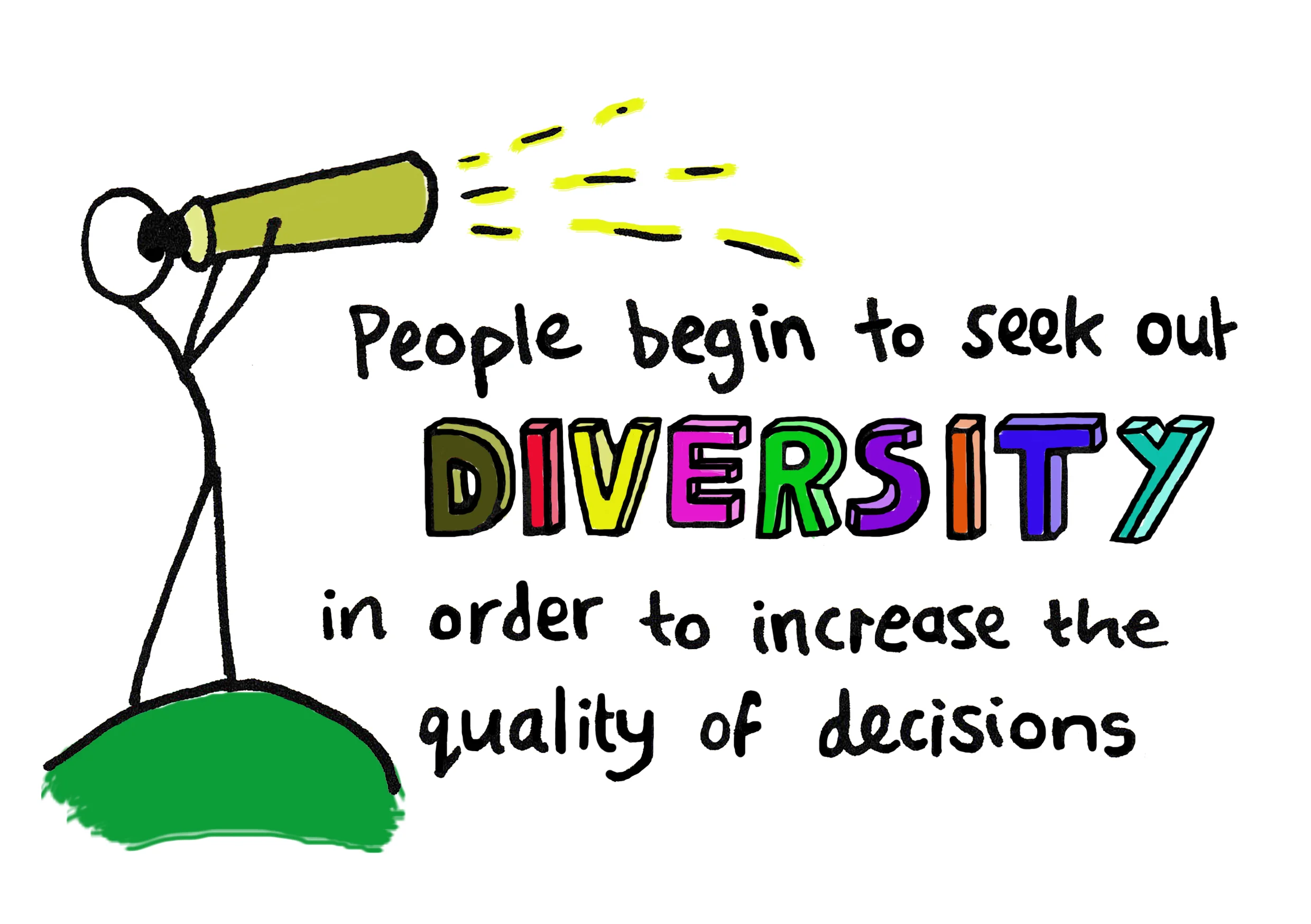
Difference is sometimes seen as potential for conflict or fragmentation. But if we see difference and diversity as an opportunity for knowledge and innovation, we can recognise that each person within an organisation or society possesses unique talents and experiences that can be contributed in a positive way. We are not limited to viewing diversity policies as a box-ticking exercise, and can reach across gender, age, ethnicity and experience to unlock and nurture potential in everyone. Studies have shown that diverse teams are smarter and create better results. So the question is, how can you support diversity in a way that makes all people feel included, valued and is also good for business?

It is our assumptions and unconscious biases that often create barriers to reframing difference and diversity as a positive strength. Challenging these assumptions in a critical and confrontational way will most likely result in increased conflict and fragmentation. It is only within an environment that fosters deep listening and non-judgement  that people are able to become aware of their assumptions and biases and potentially change their thinking and behaviour as a result. 

“Dialogue is the collective way of opening up judgements and assumptions.” - David Bohm

The practice of dialogue, supported by other creative facilitation techniques focusing on communication skills and relationship building provides a space of psychological safety for participants to come together, to voice, listen and learn from and with each other.


Moving from 'I' to 'We' - A dialogue on values and the SDGs - responsible consumption and production

In the second of our dialogue series on values and the SDGs we chose to focus on Goal 12: Responsible Consumption and Production.

After the opening mindfulness exercise and introduction to Bohm Dialogue we proceeded with two short framing activities: a word association exercise with the words ‘responsible’ and ‘efficiency’ and a partner reflection on images of consumer waste from food waste, plastic, textiles and e-waste, within differing contexts of people, animals or nature. I invited participants to open the dialogue by sharing a feeling that arose from looking at and discussing the images. These included sad, anxious, frustrated, disgusted and angry. From there we moved into the dialogue.

 
garbage-3552363_960_720.jpg
 

The first part of the dialogue had felt very ‘comfortable,’ focusing on the small changes that we can make as individuals to create bigger change - a common narrative, and one that in theory would work, but the question that also arose is ‘do we have the time for each individual to come to their own realisations and wishes to change?’

With shorter dialogues there is often more need to reflect back to the group what has been said and ask for a moment of reflection. My questions and observations were to point out the mainly ‘solutions based’ offerings by the group, to reflect again on the value of responsibility and who we are responsible to and what we are responsible for, and finally to think about what was not being said.

The question of ‘what is not being said’ was answered by one participant working with inequality - acknowledging that we were a privileged group of people, and that those from lower economic or social backgrounds may not have the mental or emotional capacity due to stress or life pressures, the financial means or knowledge to make many sustainable choices. It was also acknowledged that people in the room were self-selecting and therefore already engaged in these issues and of similar mindsets, so the usual challenge of how do we reach the disengaged or unaware people was raised. Media was offered as one solution to this, but it was also recognised that the majority and dominant media companies reinforce negative narratives on sustainability, climate change etc that actively disempower people,so cannot be relied on to support culture and behaviour change through positive interventions.

Another participant shared that they did not always want to be responsible, something that resonates very deeply with me sometimes. Responsibility is a complex value and needs the support of many other values such as accountability, courage and integrity. When and how we access and use these values needs deeper thought and consideration.

The ongoing reflection of these two dialogues exploring values and the SDGs is the need to keep  bringing the focus back to the values, connecting to and sharing the meaning of the central value of each goal. The SDGs take us between the ‘I’ and the ‘it’ - the ‘I’ being, ‘what can I change?’ and the ‘it’ being the system. System change mostly feels overwhelming and futile, so it is easy to default back to individual change and stay with the comfortable feeling of ‘if I am responsible for my choices everything will be okay,’ but we make thousands of choices everyday, and many of these are ‘thoughtless,’ a word that was introduced early on in the dialogue and stuck with me and mirrored with ‘awareness,’ reminding me of the quote- “You are personally responsible for everything in your life, once you become aware that you are personally responsible for everything in your life” - Bruce Lipton.

1.jpg
2.jpg

Even if we have a healthy degree of self-awareness, frequent barriers to making more sustainable choices are time, money, convenience and knowledge. Indeed when all of these are in our favour it does not guarantee that we will make the most sustainable choice - we might also make the choice that makes us feel good, or impresses our peers. One participant stated that we need to ‘work with human nature, not against it,’ but for this to be truly effective we would have to agree upon the framework of understanding human nature - not a simple task. Perhaps easier would be to share and connect from a place of values and to support each other to operate from this place with the courage and integrity to act differently. This came up in the check-out - to be bold and brave with our choices, even when other people might think we are ‘strange.’ However, we again face a paradox, between our desire to belong and our desire to have the courage to stand up for what we believe in. I was surprised that the dialogue did not mention community or collective responsibility, staying very much within the realm of personal responsibility, action and change, and touching on the responsibility of government and business. We were given one example of an organisation that was changing its culture by empowering its people to ask for the change they wanted. Within an organisation, that sense of community and shared values can help create the safety, energy and motivation in a group to demand change. So I was left with the question ‘how can we create more change from communities?’ or perhaps from a more personal perspective, ‘what communities do I feel I belong to, and what change can I help create from them?’

We already have many of the solutions we need to solve our global challenges, we just need to commit to the actions that implement them. Values and community feel central to this shift - we need to move from ‘what can I change?’ to ‘what can we change?’

To register for our next dialogue please visit Eventbrite. For further information about the UK Values Alliance visit their website.


World Values Day Blog - A Journey of Values and Dialogue

I was asked to write a blog post for the World Values Day website and World Values Day last week, reflecting on our dialogue series this year. World Values Day may just be once a year but like all these ‘days’ it is to highlight and encourage us to try and think about and live our values every day.

“It is a process which explores an unusually wide range of human experience: our closely held values; the nature and intensity of emotions; the patterns of our thought processes; the function of memory; the importance of inherited cultural myths; and the manner in which our neurophysiology structures moment-to-moment experience…Such an inquiry necessarily calls into question deeply held assumptions regarding culture, meaning and identity.”  

-David Bohm, On Dialogue

Following on from a revealing taster dialogue session with members of the UK Values Alliance at the end of 2017, we decided that dialogue is an ideal practice to explore, think about and reflect upon personal and shared values. This year we will have hosted 4 dialogues, preceding World Values Day, exploring values in relation to the self, others and the world around us. They have been enlightening and thought provoking as well as creating spaces for deeper connection and understanding. These dialogues are also the inspiration for the downloadable resource, available on the World Values Day website, that provides instruction and guidance on how to host a values-based community dialogue.

The practice of dialogue that we have been working with throughout the year and in the resource is Bohm Dialogue. David Bohm (1917-1992) was a theoretical physicist, most known for his theory of the implicate and explicate order. In his later life he developed a philosophy of dialogue which grew out of his observation that one of the reasons for the many crisis’s we face as a global society is fragmentation. Our societies, organisations and even ourselves are fragmented; we have lost sight of the whole and that all livings things are interconnected, interdependent and interrelated.

As Bohm’s contemporary Einstein famously said, “we cannot solve our problems with the same thinking we used to create it.”

5.jpg

This is why Bohm recognised that what we so desperately need is new thinking, and that we struggle to arrive at this new thinking because we do not create the time and space to come together and meet in a meaningful way or create the conditions in which we can allow new thinking to occur. Values are so intrinsic to a dialogue practice and combined they provide us with a potentially powerful tool for positive change.

As local and global communities, we are being held back by divisive, argumentative and accusatory ways of communicating. Dialogue presents another way of communicating with each other; allowing us to connect through meaning and values and to generate new ways of thinking about the people and the world around us.

In today’s complex times we need to come together in dialogue in order to listen, connect, understand, learn and grow. As communities we find time and space to come together and think and act on things that are important to us. Communities share common interests, and they give us a sense of belonging and participation. We can also find this sense in dialogue together.

We often get stuck; stuck saying the same things, thinking the same thoughts or acting the same way because we can’t get beyond our traditional modes of communication: those of monologue, debate and discussion, to arrive at a deeper level of meaning and understanding. Dialogue allows us to reach this deeper level, and create new ways of thinking by sharing meaning together. This shared meaning has been abundant in our dialogue series as we went on a journey of values and dialogue.

In our first dialogue we explored and shared meaning around personal values: what they are, where they come from, how we action them, what can challenge them and what meaning they bring to our lives. It generated some interesting thinking and areas for further exploration such as  whether value based behaviour is a choice and what can compromise it, often creating the value-action gap we are striving to close; and what are the small things that we can do to live our values, starting from smiling at people in public places and asking those who serve us daily, ‘how are you?’

“We are relating to each other at a very deep level and that’s a very powerful thing” -dialogue participant

In our second dialogue exploring values and others one of the topics we arrived at was litter, which was given as an example of behaviour of others that is hard to understand and tolerate. Why would someone choose to litter our shared environment, and equally what drives others to pick it up when it is not theirs. This proved a very good example and raised two further points around the values of acceptance and understanding. Some felt that acceptance of the person who had littered was part of understanding the human condition; we are all doing the best we can, with what we have. Others raised concern that an acceptance of people dropping litter was parallel to doing nothing and becoming apathetic. For some acceptance means non-action, for others acceptance leads to action; for is it possible to encourage the person that litters to stop littering if we show them anger and aggression or if we meet them with acceptance and love.

“There can’t be understanding, without understanding. – dialogue participant

In our third dialogue we set out to explore values and how they influence our relationship with the world around us. One powerful reflection by a participant was on the distinction between operational values that drive day-to-day behaviour and idealistic values that might help him aspire to and become to the ‘next best version of myself,’ and asked how we could support the tension between ‘who I am today and who I could be tomorrow.’ The ability to see ourselves and our values as dynamic and evolving allows us to face challenging situations or people with compassion and create the space and conditions for change. The question of whether ‘bad people’ have values arose in the dialogue and it was suggested by some that it is not a case of judging people as ‘good’ or ‘bad’ but instead meeting them with understanding, empathy and compassion. When we become focused on the lack of values in others, we can also lose touch with our ability to respond from a place of our own personal values. If we want others to change we need to ask ourselves whether they are likely to do so when met with judgement and blame, or with love and understanding.

“Values are in reality all defined by how you interact with other people and the way you behave in the world.” – dialogue participant

In the dialogue series we have experienced first-hand some of the benefits to individuals participating in a dialogue, which can be; to feel valued by participating, being listened to, seen and accepted; to understand themselves better by reflecting upon and speaking their thoughts; and to understand others better by listening without judgement, to different points of view and other people’s experiences.

3.jpg

Equally there are collective benefits to communities that take part in dialogue, such as, to be able to move beyond conflict and challenges by uncovering assumptions and unconscious biases; to gain insights and spark ideas that help form solutions that benefit everyone; and to improve relationships by building trust, empathy and understanding.

If you feel part of a community it is likely that there is something that binds you together, through common interests, values, and a sense that it is important enough for you to care about and give your time to. When something is important to us, very often we have different reasons for its importance. Without good communication it can be challenging to express this importance within the group, or to people outside of the group. This is why we need dialogue: in the same way that possessing a strong sense of values can strengthen community, being in dialogue together can also strengthen community.

We tend to jump to defend what is important to us. When we defend an opinion we inhibit our ability to be able to ‘think together’ because our energy and focus is going into defending, we become closed. In dialogue we need to be able to stay open, noticing what is occurring in us, whilst bringing attention to what is being said by others and the group.  We all have things that are important to us, and these are shaped by past experiences as well as familial, cultural and social framing. Therefore, it is important to realise that very often our opinions are intrinsically tied up with our sense of self and identity. We fear that if our opinions are challenged, our very sense of being and who we are is challenged also. Through dialogue we are able to see ourselves as a unique part of a whole community, to understand that what we see in others, whether we like it or not, is also in us. We welcome all thoughts and feelings because to dismiss, ignore or exclude something or someone is to fragment the community, and deny something, if only a potentiality, that is also within us.

If you are part of a community and have a desire to think about the potential of your community and what you would like to apply it to, to improve the lives of yourself and others, then please use our values-based community dialogue resource,  and let us know what meaning you create together!